
Pricing on the WhatsApp Business Platform | Developer Documentation
Pricing on the WhatsApp Business Platform
Updated: Mar 30, 2026
This document explains how pricing works on the WhatsApp Business Platform.
Cloud API and Marketing Messages API for WhatsApp
To align with industry-standards, effective July 1, 2025, Meta now charges on a per-message basis:
"type":"template").Rates vary based on the template’s category and the recipient WhatsApp phone number’s country calling code.
Meta provides value to businesses in several ways:
"type":"text", "type":"image", and so on). These can only be sent within an open customer service window. See Sending messages for a list of message types.Utility templates delivered within an open customer service window are free.You can unlock lower rates for utility and authentication template messages, based on messaging volume.All messages are free for 72 hours, including template messages, if sent within an open free entry point window.
Pricing explainer
Our pricing explainer PDF outlines how Meta charges and the various ways Meta provides value to businesses, in PDF form:
Pricing Explainer PDF
Message template categories
Unlike non-template messages, template messages are the only message type that can be sent outside of a customer service window. Templates can be categorized as:
See Template categorization to learn how template categorization works.
Template messages vs. non-template messages
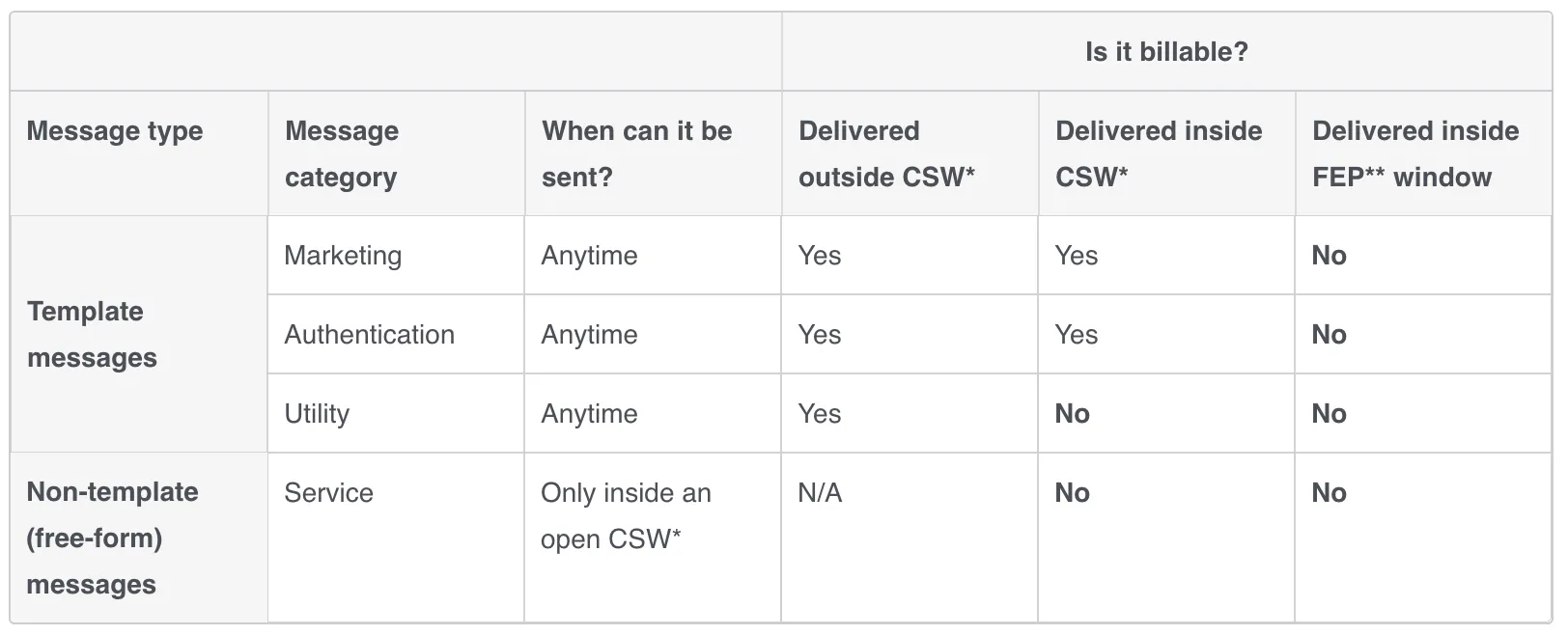
Businesses are responsible for reviewing the category assigned to their approved templates. Whenever a template is used, a business accepts the charges associated with the category applied to the template at time of use.
Charge example
In the example below, a business sends 4 messages to a WhatsApp user but is only charged for 2 (1 marketing charge, 1 utility charge).
0
You send a marketing template message to a WhatsApp user, promoting your new product.
Marketing
All marketing template messages are charged.
2
The user messages you about the product.
This opens a 24 hour customer service window (“CSW”).
-
Messages sent from a WhatsApp user to a business are not charged.
3
You send a text message to the user (
"type":"text"), describing the product in more detail.None
All non-template messages are free within an open customer service window.
4
The user purchases the product and you send them a utility template confirming their order.
None
The CSW is still open, and utility templates sent within an open CSW are free.
26
The CSW closes, which means you can no longer send non-template messages.
-
24 hours have passed since the user last messaged you.
30
You send a utility template message to the user, updating them on their order.
Utility
Utility template messages sent outside of a CSW are charged, and no open CSW exists between you and the user.
Pricing calendar
To better enable our customers to plan and prepare for pricing updates, the following pricing calendar applies for messaging and voice on the WhatsApp Business Platform:
Rate card update
Updating the rate for a given market–product
Updating the volume tiers for a given market–product (utility and authentication only)
Moving a market from one pricing region (e.g. “Other”) to another or to be standalone on the rate card
1 month
Pricing model add-on
Our July 1, 2025, introduction of new volume tiers for utility and authentication messages
3 months
Pricing model change
Our July 1, 2025 update to our pricing model, from conversation-based pricing to per-message pricing
6 months
Rates
Rate cards and volume tiers
These rate cards reflect our current rates and volume tiers, effective April 1, 2026, based on WhatsApp Business Account timezone. This information is also available interactively on our WhatsApp Business website.
Updates to rate cards
Below represents future updates to our rates. See our rate cards above for current rates.
Rate cards effective July 1, 2026
Effective July 1, 2026, as of 9am PT – Eligible customers can create new WhatsApp Business Accounts in BRL (Brazilian Reals). This is only available for Solution Partners and directly-integrated clients whose Sold-To country is Brazil in Billing Hub. Per our pricing calendar, Meta will publish per-message rates in BRL by June 1, 2026.
Billing localization for India and Brazil
Meta is introducing billing localization to help eligible customers to better manage costs of messaging amidst currency fluctuations. This will apply to the markets below, and specifically to Solution Partners and directly-integrated clients whose Sold-To country in Billing Hub is a market below:
Previous updates
Authentication-international rates
Specific countries have an authentication-international rate. Our rate cards reflect these rates. See Authentication-International rates to learn about these rates and if they apply to you.
Country calling codes
Charges for conversations are based on the country calling code of the recipient WhatsApp phone number. The table below shows how Meta maps country calling codes to countries or regions. If a country is not listed below, it maps to Other.
This information is also available in a CSV file:
Country Calling Codes and Regional Rate Mapping CSV
Countries
Argentina
Brazil
Chile
Colombia
Egypt
France
Germany
India
Indonesia
Israel
Italy
Malaysia
Mexico
Netherlands
Nigeria
Pakistan
Peru
Russia
Saudi Arabia
South Africa
Spain
Turkey
United Arab Emirates
United Kingdom
Brazil
Chile
Colombia
Egypt
France
Germany
India
Indonesia
Israel
Italy
Malaysia
Mexico
Netherlands
Nigeria
Pakistan
Peru
Russia
Saudi Arabia
South Africa
Spain
Turkey
United Arab Emirates
United Kingdom
54
55
56
57
20
33
49
91
62
972
39
60
52
31
234
92
51
7
966
27
34
90
971
44
55
56
57
20
33
49
91
62
972
39
60
52
31
234
92
51
7
966
27
34
90
971
44
North America
Canada
United States
1
1
Rest of Africa
Algeria
Angola
Benin
Botswana
Burkina Faso
Burundi
Cameroon
Chad
Republic of the Congo (Brazzaville)
Eritrea
Ethiopia
Gabon
Gambia
Ghana
Guinea-Bissau
Ivory Coast
Kenya
Lesotho
Liberia
Libya
Madagascar
Malawi
Mali
Mauritania
Morocco
Mozambique
Namibia
Niger
Rwanda
Senegal
Sierra Leone
Somalia
South Sudan
Sudan
Swaziland
Tanzania
Togo
Tunisia
Uganda
Zambia
Zimbabwe
213
244
229
267
226
257
237
235
242
291
251
241
220
233
245
225
254
266
231
218
261
265
223
222
212
258
264
227
250
221
232
252
211
249
268
255
228
216
256
260
263
Rest of Asia Pacific
Afghanistan
Australia
Bangladesh
Cambodia
China
Hong Kong
Japan
Laos
Mongolia
Nepal
New Zealand
Papua New Guinea
Philippines
Singapore
Sri Lanka
Taiwan
Tajikistan
Thailand
Turkmenistan
Uzbekistan
Vietnam
93
61
880
855
86
852
81
856
976
977
64
675
63
65
94
886
992
66
993
998
84
Rest of Central and Eastern Europe
Albania
Armenia
Azerbaijan
Belarus
Bulgaria
Croatia
Czech Republic
Georgia
Greece
Hungary
Latvia
Lithuania
Moldova
North Macedonia
Poland
Romania
Serbia
Slovakia
Slovenia
Ukraine
355
374
994
375
359
385
420
995
30
36
371
370
373
389
48
40
381
421
386
380
Rest of Western Europe
Austria
Belgium
Denmark
Finland
Ireland
Norway
Portugal
Sweden
Switzerland
43
32
45
358
353
47
351
46
41
Rest of Latin America
Bolivia
Costa Rica
Dominican Republic
Ecuador
El Salvador
Guatemala
Haiti
Honduras
Jamaica
Nicaragua
Panama
Paraguay
Puerto Rico
Uruguay
Venezuela
591
506
1 (809, 829, 849)
593
503
502
509
504
1 (658, 876)
505
507
595
1 (787, 939)
598
58
Rest of Middle East
Bahrain
Iraq
Jordan
Kuwait
Lebanon
Oman
Qatar
Yemen
973
964
962
965
961
968
974
967
Other
All other countries
Varies by country
Volume tiers
You can unlock lower utility and authentication rates based on the number of messages you send in a month.
Tiering accrual
Key dynamics
Volume tiers examples
The table below is illustrative and only highlights the dynamics of volume tiers. Please refer to our rate cards to see the rates charged.
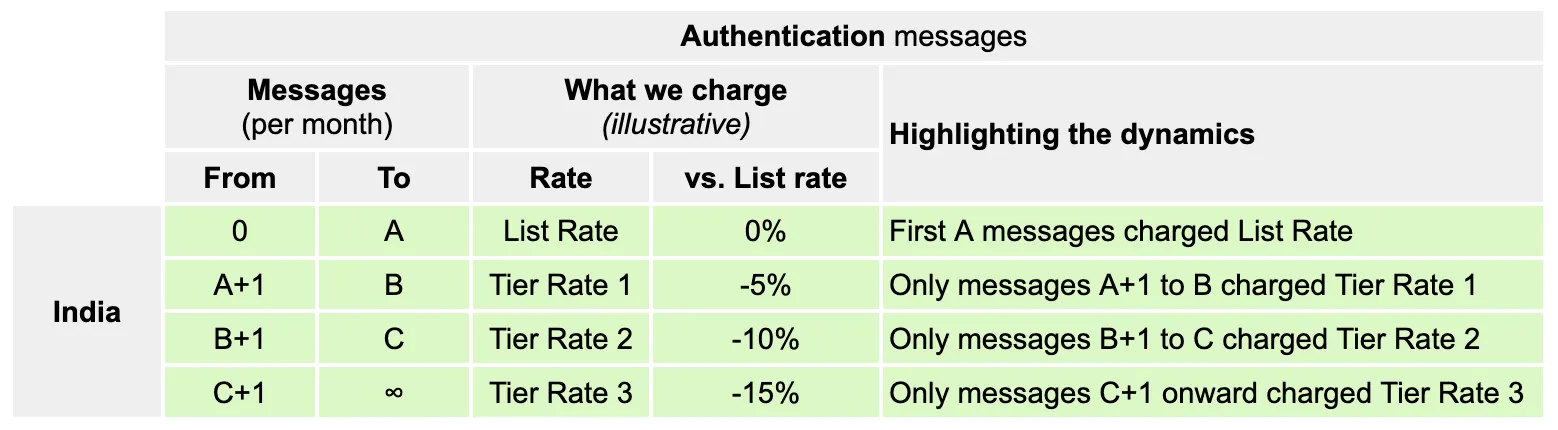
Below are several examples to highlight how the tiers work and what is charged in a given month, for a given market–category. These examples refer to the illustrative table above:
Example 1: A business that sends a total of B authentication messages in a month to India is charged:
Example 2: A business that starts to be charged our authentication-international rates on the 15th day of the month:
Example 3: A business has 3 WABAs sending authentication messages to India. For WABA A, it is still July 31 based on their timezone. For WABAs B and C, it is already August 1 based on their timezone. For July, the business is already being charged Tier Rate 1.
Example 4: A business has 3 WABAs, integrated across 2 solution providers. Provider 1 sends the first B messages in a given month, and provider 2 starts sending messages as of when the business is in the 3rd tier. The business does not send enough messages that month to reach the next tier. What we would charge each provider:
Tiering webhooks
Starting October 1, 2025, an account_update webhook with
event set to VOLUME_BASED_PRICING_TIER_UPDATE will be triggered when your WhatsApp Business Account reaches a new volume tier, in any market, in a given month. This complements our pricing_analytics endpoint, which will continue to provide intra-month tiering progress and tiering information for delivered messages.Example webhook:
{
tier_update_time tells when your WABA reached a higher volume tier (Unix timestamp).pricing_category tells you the template category for which your new volume tier rate applies.tier tells you the new volume tier’s lower and upper bounds.effective_month tells you the month in which your new volume tier rate is in effect.region tells you the WhatsApp user country/region for which your new volume tier rate applies.
Note that it’s possible for multiple account_update webhooks to be triggered that describe the same tier switch event. In these cases, use the webhook with the smaller
tier_update_time Unix timestamp as the official webhook.Tiering analytics
You can get volume tier information via template analytics.
Free non-template messages
Non-template messages, which can only be sent within an open customer service window, are free. These messages will have
type set to free_customer_service in the pricing object of status messages webhooks:"pricing":
Free utility template messages
Utility template messages sent within an open customer service window are free. These messages will have
type set to free_customer_service and category set to utility in the pricing object of status messages webhooks:"pricing":
Edge case
If you send a message to a WhatsApp user prior to July 1, 2025 (which is when Meta switched from conversation-based pricing to per-message pricing), a utility conversation is opened between you and a user that spans the switch to per-message pricing (the conversation was opened before the switch but won’t close until after the switch). In this case, utility templates sent to the user after the switch while the conversation is open will be free, but attributed to the open conversation. In status messages webhooks, these messages will have a
pricing_model of CBP and the utility conversation ID will be assigned to conversation.id. Once the conversation closes, subsequent utility messages will use per-message pricing, which will be reflected in new webhooks.Free Entry Point windows
If a WhatsApp user messages you via a Click to WhatsApp Ad or Facebook Page Call-to-Action button using a device running our Android or iOS app (our desktop and web apps are not supported):
FEP windows remain open for 72 hours. While open, you can send any type of message to the user at no charge. Note, however, that the customer service window is independent of the FEP window, so if the customer service window closes, you will only be able to send template messages.
New max-price feature for Marketing Messages API for WhatsApp
Starting in 2026, businesses integrated into Marketing Messages API for WhatsApp can choose to set a max-price per marketing message delivery; when a max-price is set, Meta will charge that max-price or lower for delivery.
New pricing policy for AI Providers leveraging WhatsApp Business Platform
Click here to learn more about our new pricing policy for “AI Providers” leveraging WhatsApp Business Platform, which is effective February 16, 2026 and updated as of March 4, 2026.
Analytics
Use the pricing_analytics field to get per-message pricing breakdowns and tiering information for delivered messages.
Webhooks
"pricing":
The
<PRICING_CATEGORY> tells you what rate was applied (e.g. marketing). See the status messages webhook reference for a list of possible values.Note that currently, tiering information is not included in any webhooks. Use the pricing_analytics field to get tiering information for delivered messages.
Billing
Billing and billing-related actions are handled through the Meta Business Suite. See About Billing For Your WhatsApp Business Account for more information.
WhatsApp Business Calling API pricing
The WhatsApp Business Calling API has different pricing. See our Calling API pricing document to learn more.
Conversation-based pricing
Conversation-based pricing is deprecated. It was replaced with per-message pricing on July 1, 2025.